Azo Bladder ControlAZO Bladder Control Reviews: How to Read Them and What Patterns Appear
AZO Bladder Control Reviews: How to Read Them and What Patterns Appear
The short answer
AZO Bladder Control reviews are mixed. Many buyers report a gradual improvement in urgency or night trips over several weeks, while others notice no change or continued burning. Individual testimonials are weak evidence because they are self-selected and cannot separate the product's effect from natural variation. Independent testing and clinical research give a stronger picture, and a doctor can help assess symptoms that persist.
Some links on this site are affiliate links: if you buy through one, the site may earn a commission at no extra cost to you. More about this.
- How to judge a review: what the reviewer took, for how long, and whether they had other changes at the same time
- Themes that keep coming up: fewer urgent trips at night, mild stomach upset, and disappointment when nothing shifts
- Why testimonials can mislead: people who feel better are more likely to write, and natural ups and downs can look like a supplement effect
- Where stronger evidence sits: independent testing and published research, which are covered on their own pages in this hub
- When a review is not enough: symptoms that persist, return, or come with pain, blood, or fever need a doctor's look
If you are reading AZO Bladder Control reviews because you are tired of waking up three times a night or rushing to the toilet at work, you are dealing with something that disrupts sleep, focus and confidence. It is reasonable to want a quick, low-effort option before booking an appointment. The trouble is that online feedback rarely tells you what you actually need to know. This page shows you how to read it with a skeptical eye, which patterns repeat across buyer reports, and why a handful of enthusiastic stories should not settle the question. You will also see where the stronger evidence lies, so you can decide what to try next with a clearer head.
What AZO Bladder Control Is and What Buyers Expect From It
AZO Bladder Control is a supplement sold over the counter, usually marketed for urinary comfort. Its packaging and advertising tend to speak to what makes overactive bladder miserable: sudden urges to go, needing the toilet more often than you would like, and waking during the night to pass urine. Those are the symptoms people have in mind when they write feedback, so keep them in view while you read.
The key thing to understand is that this is a supplement, not a prescription medicine. It is not reviewed and licensed for treating a condition the way a drug is, and its label does not carry the same kind of clinical trial evidence behind it. That does not make every claim false, but it does mean the reviews you read are judging a supplement against personal expectations rather than a formal standard.
Most reviewers are comparing against one specific symptom they want to change. Someone may be mainly bothered by night-time trips, another by urgency that hits in the car, and a third by how often they run to the bathroom at work. A review that says "it helped" may mean the person's nights got better, while one that says "it did nothing" may have been written by someone whose main problem was urgency. Before you weigh a review, work out which symptom the writer cared about. That makes the rest of the comparison far more meaningful.
The Patterns That Show Up Across AZO Bladder Control Reviews
When you read AZO Bladder Control feedback, the same themes tend to repeat. Knowing them helps you see the overall shape of buyer experience rather than fixating on the one story that caught your eye.
What do the positive reports usually say?
The most common praise is gradual improvement. Many people who report feeling better say it came slowly, often after several weeks of daily use, not within the first few days. That timing is typical for this kind of supplement, so if you try it, set your expectations for a trial period rather than a quick fix.
What about people who saw no change?
Plenty of reviewers say nothing changed at all, including some who kept taking it for a month or more. These reports matter as much as the positive ones. They show that results vary between people.
Do people say the burning or pain went away?
Some reviews mention continued burning or pain. AZO Bladder Control is not described as treating those symptoms, so these reports are a reminder to look at what a supplement is actually meant for. Ongoing burning or pain deserves a conversation with a clinician, not more of the same supplement.
How should you treat reports of side effects?
A small number of reviews describe adverse reactions. Each one is a single account, but it should still be taken seriously. If you notice anything unusual after starting, stop and check with a clinician before continuing.
Buyer feedback shows you the range of experiences. It is not proof of how the supplement will work for you.
What reviewers report, good and bad
| Reported outcome | What reviewers say |
|---|---|
| Improvement | Gradual, often after several weeks |
| No change | Some kept taking it for a month or more |
| Continued burning or pain | Not described as treated by the supplement |
| Side effects | A small number report adverse reactions |
How to Read a Review Critically
Feedback can help you decide, but only if you know how much weight each piece deserves. Before you let it shape your choice, run it through a few quick checks.
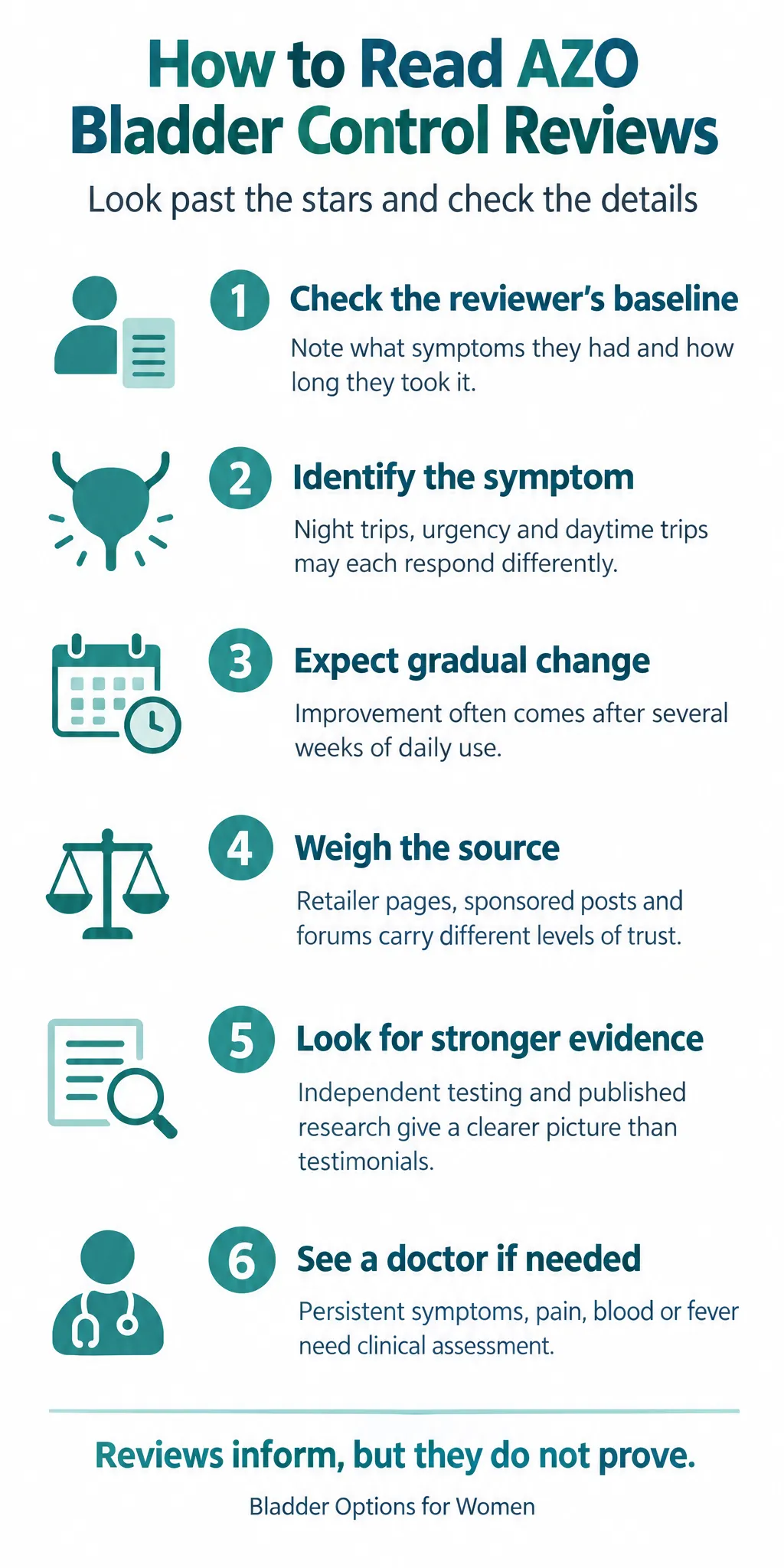
Did the reviewer have a clear baseline and a time frame? A useful write-up tells you what the reviewer's symptoms were before starting, and roughly how long they took the supplement. "It helped me within three days" means little if the person had only mild symptoms that were already settling. Be cautious with accounts that say a supplement "worked" without saying what "worked" meant.
Where did the review come from? Sort what you read into rough groups:
- Retailer pages, which show feedback the seller chooses to display and may not be checked
- Sponsored posts or paid content, which may be written to favour the supplement
- Forum threads and social media comments, which are usually unverified and anonymous
- Independent testing or reports, which describe how a product was checked and by whom
None of these is automatically false, but each carries a different level of trust.
Compare star ratings only within the same site. Each retailer sets its own rating rules, counts feedback differently and may hide or filter negative entries. A 4.5 on one site and a 4.2 on another are not directly comparable.
Look for specifics. A trustworthy write-up usually mentions:
- Timing, such as when symptoms started and when the supplement was taken
- Other medicines or supplements the person was taking at the same time
- The symptoms they had before starting, such as how often they woke at night or how urgent their urges were
Vague praise with none of these details is weak evidence, however many stars it carries.
Why Testimonials Are Weak Evidence
Testimonials are the first thing most people read when they search for azo bladder control reviews, and they are worth reading. They tell you what real people experienced, what they hoped for, and what annoyed them. But they are a weak basis for deciding whether a supplement works, and it helps to know why.
Consider who posts. People who feel better are more likely to write something, and people who feel unchanged often just stop taking the supplement without commenting. The accounts you see are therefore skewed toward good outcomes, even if most users saw nothing much happen.
Overactive bladder symptoms also rise and fall on their own. A bad week can be followed by a quieter one, and a new habit, a change in fluid intake or a seasonal shift can make a difference unrelated to any supplement. If someone starts a supplement during a flare, their improvement may simply reflect the symptoms settling down.
Placebo effects are real in any symptom-based trial, and bladder symptoms are especially sensitive to expectation. This is why controlled studies, which compare a product against a placebo, matter more than a stack of enthusiastic stories.
Finally, testimonials cannot tell you:
- whether the dose is safe over weeks or months
- what the long-term effects might be
- who should avoid the supplement, such as people on blood pressure medicine or with kidney problems
For those answers, look at labels, ingredient information and independent testing. The pages on side effects and daily safety in this hub cover those questions in more detail.
What Independent Testing and Clinical Evidence Add
Two kinds of stronger source can help you judge a supplement like Azo Bladder Control, but each answers a different question. It helps to know which one you are reading before you decide how much weight to give it.
What does independent supplement testing actually check?
Independent testing services such as ConsumerLab publish quality reports on supplements. A ConsumerLab report card looks at whether a product contains what its label says, in roughly the amounts stated, and whether it is free of contaminants. That is useful, because it tells you a bottle is probably what it claims to be. It does not tell you whether the product reduces urgency or frequency. Read a passing quality result as "this is what it says it is," not as "this will help your bladder." If the full report is behind a member login, check whether the free summary or news releases mention the specific brand and product you are considering.
How should I read clinical studies on the ingredients?
Many supplements in this category contain ingredients that have been studied separately, such as cranberry, D-mannose or other compounds. Cranberry juices and cranberry supplements are sometimes studied in the context of urinary tract infections, which is a different problem from overactive bladder. When you read a study, look at three things:
- Dose: Was the amount tested the same as what the supplement contains?
- Duration: Did people take it long enough for an effect to show, and did the study measure bladder symptoms directly?
- Population: Who was studied? Results from women with urinary tract infections may not apply to women with overactive bladder symptoms.
A study of one ingredient at one dose does not automatically prove a finished blend works.
What if the evidence is thin?
Where published research is limited or unclear, say so plainly. A lack of studies is not proof that a supplement fails. It usually means nobody has tested it well yet. Treat that gap as uncertainty, not as a verdict. For side effects, safety questions and a fuller look at the evidence, see the related pages in this hub.
Types of evidence and what each answers
| Source | What it checks | What it does not show |
|---|---|---|
| Buyer testimonials | Personal experience and expectations | Whether the supplement works for you |
| Independent quality testing | Label accuracy and contaminants | Whether bladder symptoms improve |
| Clinical studies on ingredients | Effects of a tested dose over time | Results for a finished blend |
A Practical Way to Decide and When to See a Doctor
If you decide to try a supplement like Azo Bladder Control, it helps to go in with a clear plan rather than relying on how a review made you feel. Before you start, keep a simple bladder diary for two to three weeks. Note how many times you pass urine in a day and overnight, roughly how much you drink, and how often you feel a sudden urge or leak. Without a baseline, it is easy to credit a supplement for changes that were really just day-to-day variation.
Stop taking the supplement and seek advice promptly if you notice any of the following:
- An allergic reaction, such as a rash, swelling, itching or difficulty breathing
- New or worsening pain in your back, side or lower abdomen
- Blood in your urine, or urine that is cloudy or smells strongly
- A fever, chills or feeling generally unwell
- Symptoms that get worse rather than better
Speak with a doctor or pharmacist before combining any supplement with other medicines. This matters most if you take blood pressure medication, have kidney concerns, or are on prescribed treatment for another condition.
Finally, if urgency or frequency persists for more than a few weeks, arrange a medical assessment. These symptoms can have causes, including infections and other conditions, that a supplement will not address. A proper check gives you a clear answer and a route to treatment that fits your situation.
What hands-on reviewers found
These are other people's hands-on tests, summarised and credited to them. Watch the full videos for their complete reviews.
Dr. Bri's Vibrant Pelvic Health: Uresta Review for Bladder Leaks and Pelvic Support 💖 Reusable, Over-the-Counter
Dr. Bri thinks Uresta is a practical, reusable, over-the-counter option that gives her mild prolapse support during activity, most comfortable at the smallest size, though it is not designed as a prolapse device and works best combined with
- The reviewer says she feels supported for her very mild prolapse when using Uresta, especially when constipated, though she does not experience bladder leaks. (at 8:23)
- She finds the smallest size, size three, works best for her, and says the sizing range lets users step up or down for more or less support. (at 10:10)
- She prefers Uresta because it is reusable, unlike Poise Impressa, which she says must be thrown away after each use and contains plastic. (at 10:44)
Frequently asked questions
Does AZO help the bladder?
AZO Bladder Control is marketed as a supplement for urinary urgency and frequent urination, but the evidence behind it is limited. Most of what people say about it comes from personal accounts rather than controlled studies. Whether it helps any individual depends on the cause of their symptoms, so it is worth checking the ingredient list and talking with a doctor if symptoms are significant.
How to calm down an overactive bladder naturally?
Common approaches include drinking fluids steadily through the day rather than in large amounts, cutting back on caffeine, alcohol and very acidic drinks, and timing bathroom trips. Pelvic floor exercises done consistently are also widely recommended. Some people find these changes help, though results vary and symptoms that persist should be assessed by a clinician.
Is there any over-the-counter bladder control medication available?
Yes. Some products sold without a prescription are aimed at bladder urgency, including supplements and some pharmacy items. They differ widely in ingredients and in how much evidence supports them. Reading the active ingredients, checking them against any medicines you already take, and asking a pharmacist are sensible first steps before buying.
What happens if you take too much AZO?
Taking more than the label directs can increase the chance of side effects, and the exact effects depend on the ingredients in the supplement. Possible reactions reported for bladder supplements include stomach upset, dry mouth, or drowsiness. If you take more than recommended and feel unwell, contact a pharmacist, poison control, or a doctor promptly, and bring the packaging with you.