Azo Bladder Control12 Bladder Control Supplements for Women: What to Check Before You Buy
12 Bladder Control Supplements for Women: What to Check Before You Buy
The short answer
The best bladder control supplements for women are those with clear, labelled doses of ingredients that have been studied in people with urinary symptoms, from a manufacturer that publishes its testing. Common options include cranberry, D-mannose, probiotics, pumpkin seed and some vitamins, but evidence for most is limited. Check for drug interactions, especially with blood thinners, and see a doctor first if you have blood in urine, pain, fever or sudden new symptoms.
Some links on this site are affiliate links: if you buy through one, the site may earn a commission at no extra cost to you. More about this.
If you have been searching for a bladder control supplement for women, you are probably tired of frequent trips to the bathroom and sudden urges that get in the way of work, sleep and everyday plans. You want something you can try at home before committing to a prescription or a doctor's visit.
This guide covers 12 bladder control supplements for women, and it is the buying checklist that sits behind them. The products were chosen because they are sold for urinary comfort and show up often in buyer searches and forum discussions. We did not choose them on price or on how good the marketing sounds.
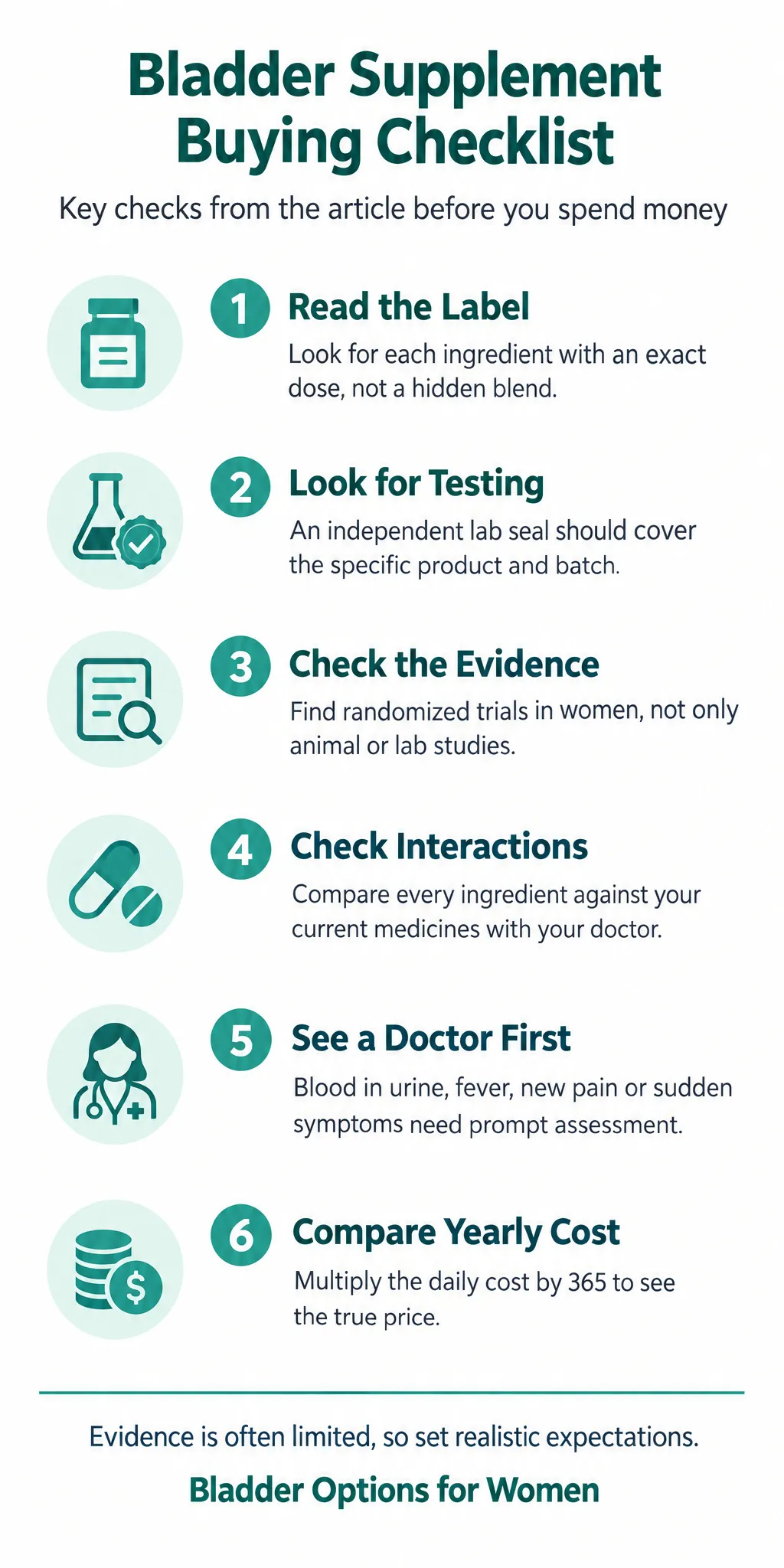
Before you spend money, it helps to know what to look for. The label should list each ingredient with its exact dose, not a proprietary blend that hides the amounts. The ingredients should have been tested in people with urinary symptoms, and the company should publish its testing. Cost matters too, because a product that is affordable for one month can become expensive over a year of daily use.
I have made a point of being plain about what is known and what is not. For most supplements in this category, the research is small or mixed, so I will say so where it applies rather than promise results.
Let's dive in.
Options compared at a glance
| Option | Best for | Key feature |
|---|---|---|
| Ingredient Transparency | Judging label clarity | Exact amount per ingredient |
| Third-Party Testing | Checking label accuracy | Independent lab seal |
| Quality of the Evidence | Separating proof from marketing | Randomized trials in women |
| Drug and Health Interactions | Safety before starting | Check against current medicines |
| Pelvic Floor Exercises | No-cost first step | Squeeze 3 to 5 seconds, 8 to 12 reps |
| Bladder Training and Fluid Habits | Habit-based management | Stretch time between bathroom trips |
| Reusable Over-the-Counter Support Devices | Mild prolapse support during activity | Size three worked best for reviewer |
| Probiotics and Gut-Bladder Products | Possible UTI prevention | Strain and dose listed on label |
A closer look at each
Ingredient Transparency: A label you can actually read is the first filter. Look for each ingredient listed by its name and an exact amount per serving, such as "cranberry extract 500 mg" rather than a "proprietary blend" with no numbers. If you cannot tell how much of an ingredient you are taking, you cannot compare the product with others or judge whether the dose matches what studies used. I start with this check because a vague label usually means the rest of the decision is guesswork.
Third-Party Testing: This shows whether the label matches what is in the bottle. Look for a seal from an independent lab such as USP, NSF or ConsumerLab, and check whether the seal covers that specific product and batch rather than just the company. Self-declared "quality tested" wording on its own tells you little, because the manufacturer is the one making the claim.
Quality of the Evidence: This separates proven benefit from marketing. Find the ingredient in the product and check whether it has been tested in randomized trials on women with overactive bladder or urinary urgency, not just in animals or in a lab dish. Many supplement pages cite a single small study on a different condition, so a result in healthy volunteers or a related symptom should be treated as a lead, not proof.
Drug and Health Interactions: This is the most important safety check before starting anything. Make a list of every prescription, over-the-counter medicine and supplement you take, then check each ingredient against it, especially blood pressure drugs, blood thinners, diuretics and sedatives. Talk to your doctor or pharmacist before the first dose if you have kidney disease, are pregnant, or take any regular medication, since "natural" ingredients can still interact with drugs.
Common Side Effects: These help you judge whether a product is tolerable for daily use. Check the label and the manufacturer's leaflet for side effects such as stomach upset, constipation, dry mouth, headache or drowsiness, and note which ones would make you stop. A product you feel the need to take at a fixed time each day only works for you if you can keep taking it without those effects getting in the way of work or sleep.
Cost Over Time: A supplement is a recurring cost, which many buyers underestimate. Divide the price by the number of doses in the bottle to get a cost per day, then multiply by 30 and 90 to see what a month and three months will really cost. A product that looks cheap on a single bottle can cost more than a prescription over a year, so compare the yearly figure, not the sticker price.
Red-Flag Symptoms That Need a Doctor: Some bladder symptoms are not safe to treat yourself. Blood in your urine, fever or back pain with urination, pain that is new, sudden weakness or numbness in the legs, or trouble emptying your bladder completely all warrant a prompt doctor visit before you try any supplement. Urgency and frequent trips to the toilet are common, but a change that comes on suddenly or with other symptoms should be assessed rather than self-treated.
Pelvic Floor Exercises: Pelvic floor muscle training, often called Kegel exercises, is a no-cost, evidence-supported first step for many women with urinary incontinence. A typical routine is squeezing and lifting the pelvic floor muscles for about 3 to 5 seconds, relaxing for the same time, and repeating 8 to 12 times, several times a day. Use it as the baseline to compare any product against, since it asks nothing of your wallet or your medicine cabinet.
Bladder Training and Fluid Habits: Bladder training means gradually stretching the time between bathroom trips, often starting from every hour and adding 10 to 15 minutes each week as you feel able. Adjusting fluid habits matters too: drinking roughly 1.5 to 2 liters a day spread across the day is a common guideline, while cutting back heavily on caffeine and alcohol can ease urgency for some people. These habits often make more difference than a supplement, and they cost nothing to start.
Reusable Over-the-Counter Support Devices: Some buyers consider reusable devices alongside supplements, and this is a different category altogether. In Dr. Bri's Vibrant Pelvic Health's review of Uresta, she says she feels supported for her very mild prolapse when using it, especially when constipated, though she does not experience bladder leaks. She found the smallest size, size three, worked best for her, and said she uses it only during walks or runs. She also notes it is not designed as a prolapse device.
Probiotics and Gut-Bladder Products: Probiotics are a popular category marketed for bladder health, but the evidence is mixed and mostly limited to small or short studies. Some research suggests certain strains may help reduce urinary tract infections in women, while evidence for overactive bladder symptoms is much weaker. Treat claims about gut-bladder links as unproven, check which strain and dose a product lists, and do not assume a probiotic will control urgency or leaks.
D-Mannose and Cranberry Products: D-mannose and cranberry products are widely sold for urinary health, but most of the research behind them looks at urinary tract infection prevention rather than overactive bladder. Evidence for cranberry in preventing UTIs is mixed, and studies on D-mannose are limited and small. If your concern is urgency or leaks rather than infection, these products are unlikely to address the problem directly, and a UTI still needs a doctor's assessment.
What hands-on reviewers found
These are other people's hands-on tests, summarised and credited to them. Watch the full videos for their complete reviews.
Dr. Bri's Vibrant Pelvic Health: Uresta Review for Bladder Leaks and Pelvic Support 💖 Reusable, Over-the-Counter
Dr. Bri thinks Uresta is a practical, reusable, over-the-counter option that gives her mild prolapse support during activity, most comfortable at the smallest size, though it is not designed as a prolapse device and works best combined with
- The reviewer says she feels supported for her very mild prolapse when using Uresta, especially when constipated, though she does not experience bladder leaks. (at 8:23)
- She finds the smallest size, size three, works best for her, and says the sizing range lets users step up or down for more or less support. (at 10:10)
- She prefers Uresta because it is reusable, unlike Poise Impressa, which she says must be thrown away after each use and contains plastic. (at 10:44)
Frequently asked questions
What should I check before buying a bladder control supplement?
Start with the ingredient list and the exact amount of each ingredient per serving, not just the blend total. Look for clear dosing, a named manufacturer, and whether the label says what the product is meant to do. Check whether any ingredient interacts with medicines you already take, and compare the cost of a full month or more, since the sticker price of a single bottle can understate what you will spend over time.
Do bladder control supplements actually work for overactive bladder?
The honest answer is that evidence is mixed and often limited. Many products have small studies, short follow-up periods, or studies funded by the manufacturer. Some ingredients have been looked at more closely than others, so it helps to ask whether a product's claims rest on research on that specific ingredient and dose, or only on general wellness reasoning or customer testimonials.
Are bladder control supplements safe for women who take blood pressure medicine?
Some supplement ingredients can affect blood pressure, fluid balance, or how other drugs are processed, so you should not assume a product is safe alongside your medicines. Bring the full ingredient list to your pharmacist or prescriber before starting, especially if you take blood pressure drugs, diuretics, or anything for heart or kidney conditions.
What side effects should I watch for with bladder supplements?
Common reports across supplements of this kind include dry mouth, constipation, drowsiness, and occasionally blurred vision, depending on the ingredients. Stop the product and speak to a healthcare professional if you notice rash, swelling, breathing trouble, or symptoms that get worse. Keep a simple note of when you started and what changed, so you can tell whether a new symptom came after the supplement.
When should I see a doctor instead of trying a supplement?
See a doctor if you have blood in your urine, pain when urinating, fever, sudden changes in bladder habits, or leaks that began after a fall or injury. A supplement is not the right first step for those signs. Persistent urgency that disrupts sleep or daily life is also worth a proper assessment, because treatment options range well beyond supplements and some causes need specific checks.
Wrapping up
We have covered 12 bladder control supplements for women, and the main point is simple: check the ingredients, the dose, the interactions, and the total cost before you spend money. Most of the difference between products comes down to what is actually on the label and what evidence sits behind it.
Which of the 12 are you planning to try first, or is there one we missed that you would like us to look at?
If you want to read the product details directly, Visit the official site to see the current label and ingredient information for yourself.